
Freight Quote Automation Doesn't Have to Be All or Nothing
Freight quote automation software that works in modules: RFQ intake, rates, pricing and quotations — adopt one step at a time with FreightBy.ai.
Freight Quote Automation Doesn't Have to Be All or Nothing
When we started building FreightBy.ai, one of the first things we worked on was freight quote automation.
On paper, the process looked pretty straightforward. A customer sends an email asking for a rate, someone finds the right prices, adds the necessary charges and margin, and sends back a quotation.
But once you start looking at how this actually works, things get complicated pretty quickly.
The request might be missing a few details. The rate might be sitting in an Excel file someone updated last week, or in an email from a carrier. Someone needs to check whether it's still valid. Maybe there's a special agreement with this particular customer. And sometimes, before you can even prepare a quotation, you have to send another five emails.
What surprised me wasn't that these problems existed. It was just how much of this work was still being done manually.
And I didn't think the answer was to come in and replace the whole freight quoting process with AI.
Why freight quote automation shouldn't be all or nothing
I've spent years working with companies that already have established processes. Some of those processes have been around for a long time, and people have built their daily work around them.
Changing things is difficult, even when everyone agrees that something needs to improve.
You can't simply introduce a new system on Monday and expect everyone to change the way they've been working for years. There are existing tools, habits, responsibilities, and plenty of small details that aren't written down anywhere.
I had that in mind from the beginning when we started designing FreightBy.ai.
I wanted companies to be able to introduce automation gradually, without having to reorganize their entire operation first.
And freight quote automation seemed like a good place to apply that approach.
The same quoting job, completely different workflows
Something I found interesting while working with freight forwarders was how differently companies approached essentially the same task.
Some had fairly structured pricing processes, with rates stored in their TMS or maintained in spreadsheets. Others relied much more heavily on email conversations with carriers.
Even within the same company, different teams could have different ways of preparing quotations.
And despite all the freight quotation software available in the industry, there was still an enormous amount of manual work. People copying shipment details between systems, checking rates in spreadsheets, searching through old emails, and preparing the same kinds of quotations over and over.
A lot of this could be automated.
But imagine telling a company that spends hours every day checking carrier rates that, before we can help, they need to replace their inbox, migrate all their pricing data, and change how their team prepares quotations.
That would be a pretty strange way to solve their problem.
Modular freight quoting automation
Instead of treating freight quoting automation as one big feature, we broke the process into smaller parts from the beginning.
Reading incoming requests is one task. Extracting shipment details is another. Finding rates, checking validity, applying margins, preparing quotations, requesting missing rates from carriers, following up with customers — they're all connected, but they're not the same job.
And each of them can be useful on its own.
Say your pricing team already has a good way of calculating quotations, but spends too much time manually reading RFQs and entering shipment details.
Why should you replace the entire pricing process just to automate that?
Or maybe your team is perfectly comfortable handling customer emails, but maintaining hundreds of carrier rate sheets is becoming a nightmare.
You should be able to solve that problem without changing everything else.
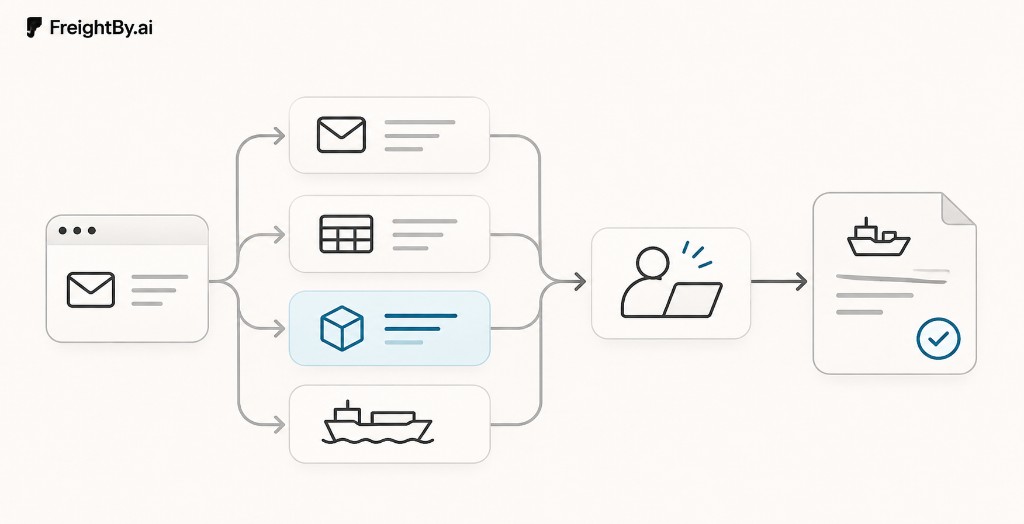
That's how we designed FreightBy.ai quoting: each part of the process can work independently, but the modules can also connect when you need a more complete RFQ-to-quote workflow.
What freight quote automation looks like in practice
Let's take a typical freight RFQ.
A customer writes:
Hi, can you quote 1x40HC from Shanghai to Valencia? Cargo ready March 18.
FreightBy.ai can pick up that email, recognize it as a quotation request, and extract the shipment details.
If something important is missing, the system can prepare a reply asking for clarification.
If the company has its rates connected, another part of the system can look for applicable pricing, check validity dates, and calculate the quotation according to the company's rules.
If there's no valid rate, it can help request one from a carrier.
Once the pricing is ready, it can prepare a quotation for someone on the team to review.
And after the quotation has been sent, it can help keep track of whether the customer replied or needs a follow-up.
That's the full workflow. But here's the important part: you don't have to use all of it.
You might only want to automate incoming RFQs. Or rate checking. Or preparing quotations from rates your team already maintains.
The rest of the process can stay exactly where it is.
AI freight quoting doesn't need to make every decision

As an engineer, I've always found it strange when people try to solve every problem with AI, especially when ordinary software could do the job more reliably.
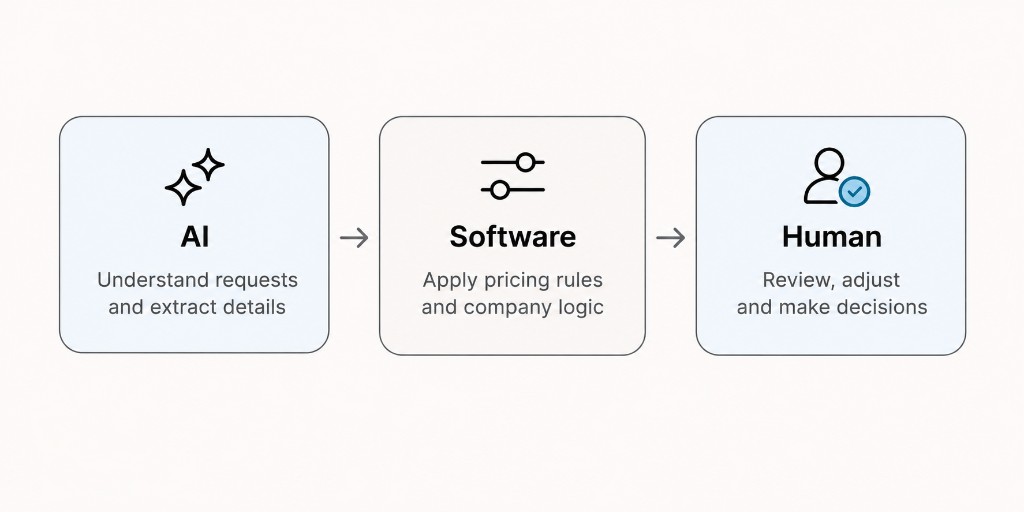
Understanding an unstructured email? AI is pretty useful there.
Extracting shipment details from a conversation with a customer? Also a good fit.
Checking whether a rate expired yesterday? You don't need a language model for that.
And deciding what margin to offer an important customer? I'd rather leave that to someone who understands the business.
That's how we approach AI freight quoting in FreightBy.ai.
We use AI where it makes sense, ordinary software where it's more predictable, and keep people involved in decisions that require their experience.
I'm not particularly interested in building a system that can demonstrate a hundred automated steps if nobody feels comfortable letting it run in their actual operation.
I'd much rather build something that people trust enough to use every day.
Start freight forwarding automation with one problem
When introducing new technology into an established company, I've found that trying to change too much at once usually creates more problems than it solves.
People need time to understand a new system, see where it helps, and become comfortable relying on it.
So with FreightBy.ai, the idea is simple.
Start with one problem that's worth solving.
Maybe it's automatically identifying quotation requests and extracting the relevant shipment details — the kind of RFQ automation that fits into the inbox you already use.
Once that's working well, connect rate sheets.
Then perhaps add quotation preparation, carrier communication, or follow-ups.
You don't need to commit to the entire workflow from day one. And you don't need to automate a process just because it's technically possible.
I think this is especially important with AI. There's a lot of excitement around systems that can supposedly run entire operations on their own, but most companies don't need that.
They need something that makes their existing team more effective.
That's what we're trying to build with FreightBy.ai.
A system that can grow with the company, one useful piece at a time, without asking people to give up control over how they work.
Because for me, the goal of freight quote automation was never to replace the people preparing quotations.
It was to give them back some of the time they spend doing everything around them.
Want to see how we built this? Book a demo — thirty minutes with a founder, on the live product.